
Designing for Electrification Without Sacrificing Beauty
There’s a certain kind of house that feels calm the moment you cross the threshold. The air is clean, the rooms hold their temperature, and the kitchen operates without announcing itself. Nothing about it feels technical, yet everything performs flawlessly. Walking through San Francisco, I often think about this kind of quiet confidence in architecture and how the best systems don’t demand attention. They simply make a home better to live in.
That is how we approach electrification in high-end residential construction and modern renovations. It isn’t a checklist, a style statement, or a mechanical layer that dominates the design. Done well, electrification disappears into the architecture, supporting the warmth of a home rather than competing with it. In San Francisco, that conversation is no longer theoretical. The city’s All-Electric New Construction Ordinance applies to all new residential and non-residential buildings that submitted initial building permit applications on or after June 1, 2021. Under that rule, space conditioning, water heating, cooking, and clothes drying systems in new construction must be all-electric, with only limited exceptions. That makes electrification not just a design preference, but an essential part of how future-facing homes are now conceived in San Francisco.
For a builder, that shift raises the bar. If all-electric systems are now part of the baseline, the real question becomes how to integrate them without making a home feel overengineered, visually busy, or stripped of character. That is where design, construction fluency, and early planning have to work together.
Related: Resilience by Design: Building for Climate, Stability, and Comfort
The Best Systems Are the Ones You Barely Notice
The common misconception about all-electric design is that it must feel clinical. In reality, the finest all-electric homes feel quieter, cleaner, and more composed precisely because the mechanical systems work harder behind the scenes.
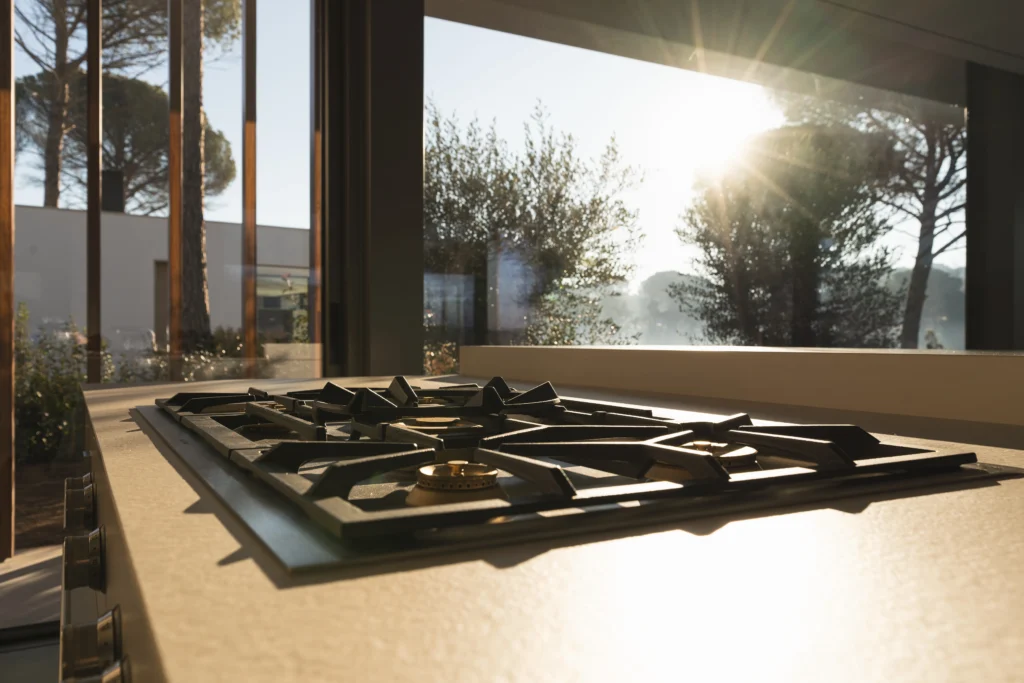
A thoughtfully designed induction kitchen doesn’t need to look futuristic to perform beautifully. ArchDaily notes that induction cooktops are driving a new movement in kitchen design by supporting both energy efficiency and a seamless, integrated aesthetic. Eliminating the visual noise of oversized vents and bulky equipment gives the space room to breathe. That isn’t just a performance win, it’s a design win. ENERGY STAR also notes that induction cooking can transfer about 85% of its energy directly to cookware, compared with roughly one-third for gas cooking products, which helps explain why it offers both faster response and a cleaner cooking experience.
“The details are not the details. They make the design.”
– Charles Eames
When electrification is handled with intention, it doesn’t feel like a layer added on top. It becomes part of the home’s natural order. That often means thinking beyond appliances and looking carefully at where equipment lives, how ventilation is integrated, how utility spaces are organized, and how systems can support comfort without visually interrupting the architecture.
Performance Without Visual Weight
When electrification is executed well, you notice the experience rather than the hardware. The utility spaces feel intentional, and the home reads as calm rather than complicated.
Data backs up this shift toward quality. Performance gains also show up beyond the cooktop. The U.S. Department of Energy says heat pump water heaters can be two to three times more energy efficient than conventional electric resistance water heaters. In practical terms, that means a home can deliver hot water and thermal comfort more intelligently, with less wasted energy, when those systems are planned correctly from the start.
The same principle applies to indoor air quality and comfort. The EPA points out that indoor air can be significantly more polluted than outdoor air, making indoor pollution sources a primary cause of residential air-quality issues. In a luxury home, mitigating this isn’t a secondary consideration; it is fundamental to how the house feels day to day.
That matters even more in a city like San Francisco, where many high-end residential projects involve tight urban lots, close neighboring structures, and renovation conditions that demand careful coordination. When electrification is addressed early, it becomes easier to hide complexity, protect clean lines, and maintain the warmth and material richness people actually want to live with. When it is left too late, the result is usually compromise.
Modern luxury is no longer just about finish selections or clean lines. It is also about what the house asks you to live with. Noise, poor ventilation, and cluttered mechanical layouts are friction points. Good design reduces that friction; good construction makes the reduction feel effortless.
A More Beautiful Way to Build
The future of residential construction isn’t mechanical, it is warm, tactile, restrained, and deeply human. Dwell recently framed home electrification as a practical design choice centered on comfort, particularly when HVAC upgrades open the door to high-performing heat pump systems. Current residential design trends consistently point toward quieter interiors, simpler forms, and performance choices that disappear into everyday life.
In that sense, San Francisco’s ordinance does more than regulate equipment choices. It pushes the design and construction community to think more holistically about what a well-performing home should feel like. If gas is no longer the default in new construction, then the opportunity is to make electric homes feel better, not just function differently. That is where beauty still matters. That is also where expertise shows.
That is the version of electrification we care about at Frontside Construction. Not the gadget-heavy showroom version, but the lived-in version where systems support the architecture, performance protects comfort, and the home always feels like a home first. For Glenn Rodgers, that value is simple: if electrification is part of the future of building in San Francisco, then it should be approached with the same care as layout, proportion, materials, and craftsmanship. The systems may be modern, but the goal is timeless, a home that feels effortless, resolved, and deeply human.
We believe in building smarter without making a house feel mechanical. Because the best future-facing homes do not show off their systems, they make good design feel entirely effortless.
Ready to elevate your space? If you are planning a modern renovation or custom home and want to approach electrification in a way that protects both performance and beauty, explore Frontside’s Services, learn more About Us, or view our Projects. Let’s build something that feels as good as it works.